
Cost of drilling a borehole in Uganda
Learn about the processes and cost estimates for water borehole drilling in Uganda

Weis Engineering Ltd is one of the borehole drilling companies in Uganda. It offers a wide range of drilling operations. Our employers range from large commercial and public water supply companies to schools, farms, and domestic properties. Cost of drilling a water borehole in Uganda depends on a some factors listed later in the document
Table of Contents
Definition
Can be defined as a deep, narrow hole made in the ground, especially to locate water or oil.
Borehole water can be used for;
- Irrigation
- Home use
- Poultry, livestock and aquaculture
- Industrial and municipal use
Steps involved in Borehole water drilling
Below are the major steps in having a borehole water well
Step 1: Hydro-geologists site the borehole
This involves a hydro-geologist visiting the site to identify the most suitable drilling location. From our site visit, we will establish an initial idea of whether the water-bearing aquifer will yield the required water quantity. Our visiting engineer will be happy to explain all the options to ensure that you get the correct system for your needs.


Cost of borehole survey in Uganda
| Borehole type | Estimated costs in Ugx | Estimated costs in USD |
| Hand pump | 1,100,000 – 1,650,000 | 290 – 435 |
| Hand pump (Advanced Tech.) | 2,500,000 – 4,000,000 | 664 – 1,060 |
| Production well | 1,300,000 – 1,800,000 | 343 – 475 |
| Production well (Advanced Tech.) | 3,500,000 – 5,000,0000 | 929 – 1,327 |
| Community/village | 1,400,000 – 3,500,000 | 370 – 924 |
| Community/village(Advanced Tech.) | 4,000,000 – 6,000,000 | 1,060 – 1,593 |
| Others (Irrigation for large fields) |
Step 2 – Drilling and Construction
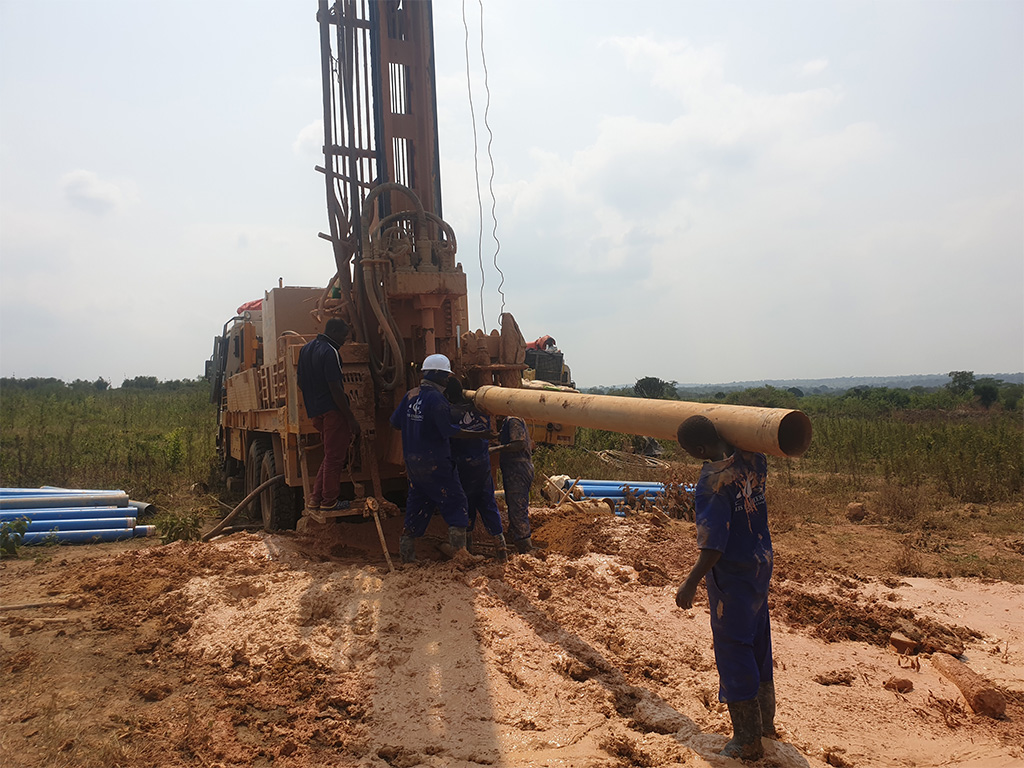
The next step is to commence with the drilling. Special machinery is used to drill deep into the earth’s surface. While the depth of an average borehole ranges between 60m – 90m, it can vary greatly from one borehole to another. Deepest observed borehole is 170 meters.
Once the borehole has been drilled, the necessary unstable lengths are cased. This is done to reinforce the ‘tube’.


Check demo borehole drilling video here and flushing here
Factors that dictate the cost of drilling in Uganda
Estimated costs for borehole drilling in Uganda
| Drilling method | Estimated costs in Ugx | Estimated costs in USD |
| Air Rotary(Open hole) – Hand pump(5 inches) | 14,000,000 – 22,000,000 | 3,716 – 5,840 |
| Air Rotary(Open hole) – Production(5 inches) | 15,000,000 – 24,000,000 | 3,960 – 6,370 |
| Air Rotary(Closed hole) – Production(5 inches) | 18,000,000 – 27,000,000 | 4,752 – 7,128 |
| Mud drilling (5 inches) | 27,000,000 – 35,00,000 | 7,128 – 9,240 |
Water borehole casing (open and closed hole)
After drilling is done, permanent pipes called casing pipes have to be installed to prevent the open holes from collapsing inside. There two casing methods i.e
Open hole where casing pipes are installed up to where a basement rock was found
Closed hole where casing pipes are installed up to where drilling stopped.
Differences between open and closed hole borehole designs
Open Hole
- Cheaper to construct since less permanent pipes will be used
- Cheaper to drill since drilling with 8” will stop at the basement rock for 5′ casing
- Requires less gravel for the same depth
- Possibility of silting hence a need for flushing after some years, this will affect pump service life
- Possibility of hanging rocks after casing, may prevent installing of a pump to the required depth
- Possibility of rock weathering, this may affect water quality and pump service life
Closed hole(Full bottom casing)
- More permanent pipes are required hence costs more
- Requires drilling with 8” up to final drilling depth for 5” casing
- Requires more gravel for the same depth
- Limited possibility of silting
- Limited possibility of hanging formations hence higher chances of installing the pump to the required depth
- Weathering may occur but doesn’t affect water pump service life and may not have an effect on water quality since gravel is put between the screen pipes and the rocks
In cases where no basement rock is encountered, closed hole design will have to be adopted.
Step 3 – Determining the yield of the borehole
Once the borehole has been drilled, the borehole may require a pump test. The borehole is pumped over a period of time to assess both the volume of water it will produce and the speed at which the surrounding rocks will release the water. The scope and length of the test pump will be dependent on a number of factors, such as anticipated flow rate, pumping hours, volume and/or legal requirements


Estimated pump testing costs in Uganda
| Borehole type/Use of water | Testing hours (Including step tests) | Estimated costs in Ugx | Estimated costs in USD |
| Hand pump | 6 hours | 600,000 – 1,800,000 | 159 – 475 |
| Domestic (Production) | 12 hours | 1,500,000 – 2,200,000 | 396 – 580 |
| Low yield production borehole* | 24 hours | 1,600,000 – 2,600,000 | 423 – 686 |
| Medium yield production borehole* | 48 hours | 2,500,000 – 3,500,000 | 660 – 924 |
| Town water supply* | 72 hours | 3,000,000 – 7,00,000 | 792 – 1,848 |
Step 4 – Pumping and piping the borehole
The kind of pumping system and piping installed in your new water borehole will largely depend on the intended use of the borehole water and borehole specifications.

Some factors affecting the final cost of motorizing a borehole
Borehole factors
- Borehole depth
- Borehole tested yield
- Dynamic water level*
- Casing depth
Pumping factors
- Required pumping volume*
- Vertical and horizontal distances from borehole point to delivery point(s)
- Power source type whether DC(Solar or batteries or AC( National grid or generator)
- Automation or manual control
- Remotely controlled features – currently works with hybrid pump controllers
- Pump impellers type whether helical rotor, Engineered plastics or stainless steel
Estimated borehole motorization costs in Uganda
| Pump type | Impeller type | Estimated pumped Volume per hour | Estimated pumped Volume per day | Total head(Static head, dynamic water level, dynamic head) | Estimated costs in UGX | Estimated costs in USD |
| Alternating current(AC) pump – National grid or AC generator power source | ||||||
| Direct current(DC) – Solar or batteries | ||||||
| Hybrid pumps |
Some factors affecting the final cost of installing a hand pump
- Static and dynamic water levels
- Type of non visible(installed inside the well) materials used on equipment like cylinder, connecting rods, pipes Materials type can include Galvanized iron, Poly Vinyl Chloride (PVC), Stainless steel
- Type of hand pump
- Site location
Estimated hand pump costs in Uganda
| Materials used | Advantages | Limitations | Estimated costs in UGX | Estimated costs in USD |
| Stainless steel(SS) connecting rods, Galvanized iron(GI) /Brass cylinder, PVC pipes | ||||
| Stainless steel(SS) connecting rods, Galvanized iron(GI) /Brass cylinder, GIpipes | ||||
| Stainless steel connecting rods, stainless steel cylinder, stainless steel pipes |
Cost analysis for a borehole
The cost of a borehole is largely dependent upon the depth and amount of casing that the borehole will require.
Geology (the type of rock formations) that has to be drill through does have some influence as do the actual ground conditions. Many people expect the easiest drilling to be into soft and loose geologies; however, the opposite is generally true. One of the main difficulties with drilling is keeping the borehole open during the drilling process; this is made more difficult if the hole is collapsing owing to the ground being loose and unstable. Many methods could be employed to prevent this from happening, including the use of drilling additives and fluids and the installation of temporary steel casing. All these factors affect the cost of a borehole.
Some field photos




Or leave us a feedback on google