
Borehole pump testing in Uganda
Definition
A pumping test is a field experiment in which a well is pumped at a controlled rate and water-level response (drawdown) is measured in one or more surrounding observation wells and optionally in the pumped well (control well) itself; response data from pumping tests are used to estimate the hydraulic properties of aquifers, evaluate well performance and identify aquifer boundaries.
Reasons for undertaking pumping tests
Pumping tests can be undertaken for a wide variety of reasons, including the following:
- To determine the reliable long-term yield (or ‘safe’ yield) of a borehole, and therefore whether or not the borehole can be regarded as a ‘success,’ and how many people it will be able to supply.
- To assess the hydraulic performance of a borehole, usually in terms of its yield-drawdown characteristics.
- To provide information on water quality. Is the water quality suitable for the intended use? Is it stable in the long term? Are there likely to be any problems such as drawing in saline or polluted water after extended periods of pumping?
- To optimize operational pumping regimes (especially from multiple-borehole sources), including selecting the most suitable pumping plant for long-term use, and estimating probable pumping and/or treatment costs
- To help determine the correct depth at which the permanent pump should be installed in the borehole.
- To derive the hydraulic properties of the aquifer. Pumping tests are the classic (and perhaps the only) way to derive in situ aquifer hydraulic properties, such as transmissivity and the storage coefficient, or to reveal the presence of any hydraulic boundaries.
- To determine the effects of abstraction on neighboring abstractions
- To determine the environmental impact of the abstraction. All groundwater abstraction eventually has an impact; it is only a matter of where, when, and whether or not the impact is acceptable.
It is important to define the aims of each test before the test is carried out, as this will greatly influence the choice of test and the parameters that need to be monitored.
Recommended Tests and Durations
| Use Of Water | Test | Duration | Recovery Test |
| Stock or domestic | Extended step | Total 6 hours | Up to 3 hours |
| Hand pump | Extended step | Total 6 hours | Up to 3 hours |
| Town water supply Low-yield borehole | Step Constant discharge | 4 x 1 hour 24 hours | – Complete |
| Town water supply High-yield or main borehole | Step Constant discharge | 4 x 1 hour 72 hours or more | – Complete |
Main types of pumping tests
There are many different types of pumping test from which to choose. The main types are as follows:
Step test
Designed to establish the short-term relationship between yield and drawdown for the borehole being tested. It consists of pumping the borehole in a series of steps, each at a different discharge rate, usually with the rate increasing with each step. The final step should approach the estimated maximum yield of the borehole.
Constant-rate test
Carried out by pumping at a constant rate for a much longer period of time than the step test, and primarily designed to provide information on the hydraulic characteristics of the aquifer. Information on the aquifer storage coefficient can be deduced only if data are available from suitable observation boreholes.
Recovery test
Carried out by monitoring the recovery of water levels on cessation of pumping at the end of a constant-rate test (and sometimes after a step test). It provides a useful check on the aquifer characteristics derived from the other tests but is valid only if a foot-valve is fitted to the rising main; otherwise water surges back into the borehole.
These tests can be carried out singly or in combination. A full test sequence usually starts with a step test, the results of which help to determine the pumping rate for the constant-rate test, with a recovery test completing the sequence.
Factors that dictate the cost of pump testing
- Planned use of water i.e hand pump, domestic, community supply, to mention
- Estimated borehole yield i.e low, medium, high
- Step and constant pumping duration
- Site location and accessibility, and other factors
Estimated costs of pump testing in Uganda
| Description | Unit | Qty | Unit cost(Ugx) | Total(Ugx) | |
| Preliminaries and General | |||||
| 1. 1 | Mobilisation of personnel, equipment, and materials | Ls | 1 | Depend on location | – |
| 1. 2 | Provision of all temporary facilities by the Contractor | Ls | 1 | Depend on location | – |
| Sub Total – Preliminaries and General | Not included | ||||
| Pump and Recovery testing | |||||
| 1. 3 | Test pump installation and removal | Ls | 1 | 180,000 | 180,000 |
| 1. 4 | Step test | Hrs | 3 | 40,000 | 120,000 |
| 1. 5 | Constant test(Depends on duration) | Hrs | 24 | 35,000 | 840,000 |
| 1. 6 | Recovery test | Hrs | 1 | 50,000 | 50,000 |
| 1.7 | Labour charges | days | 2 | 150,000 | 300,000 |
| 1. 8 | Report preparation | Ls | 1 | 80,000 | 80,000 |
| 1.9 | Water quality test at NWSC(Not included) | Ls | 1 | ||
| Sub Total – Pump and Recovery testing(24Hrs) | 1,570,000 |
Pump testing report layout
- Introduction
- Step one(1) results in tabular form
- Step two(2) results in tabular form
- Step three(3) results in tabular form*
- Recovery results for step tests in tabular form
- Steps and recovery results in graphical format
- Constant test results in tabular form
- Constant and recovery test results in graphical format
- Recommendations
Sample pump testing report
Some of our past pump testing projects
Pump testing in Kalaki district

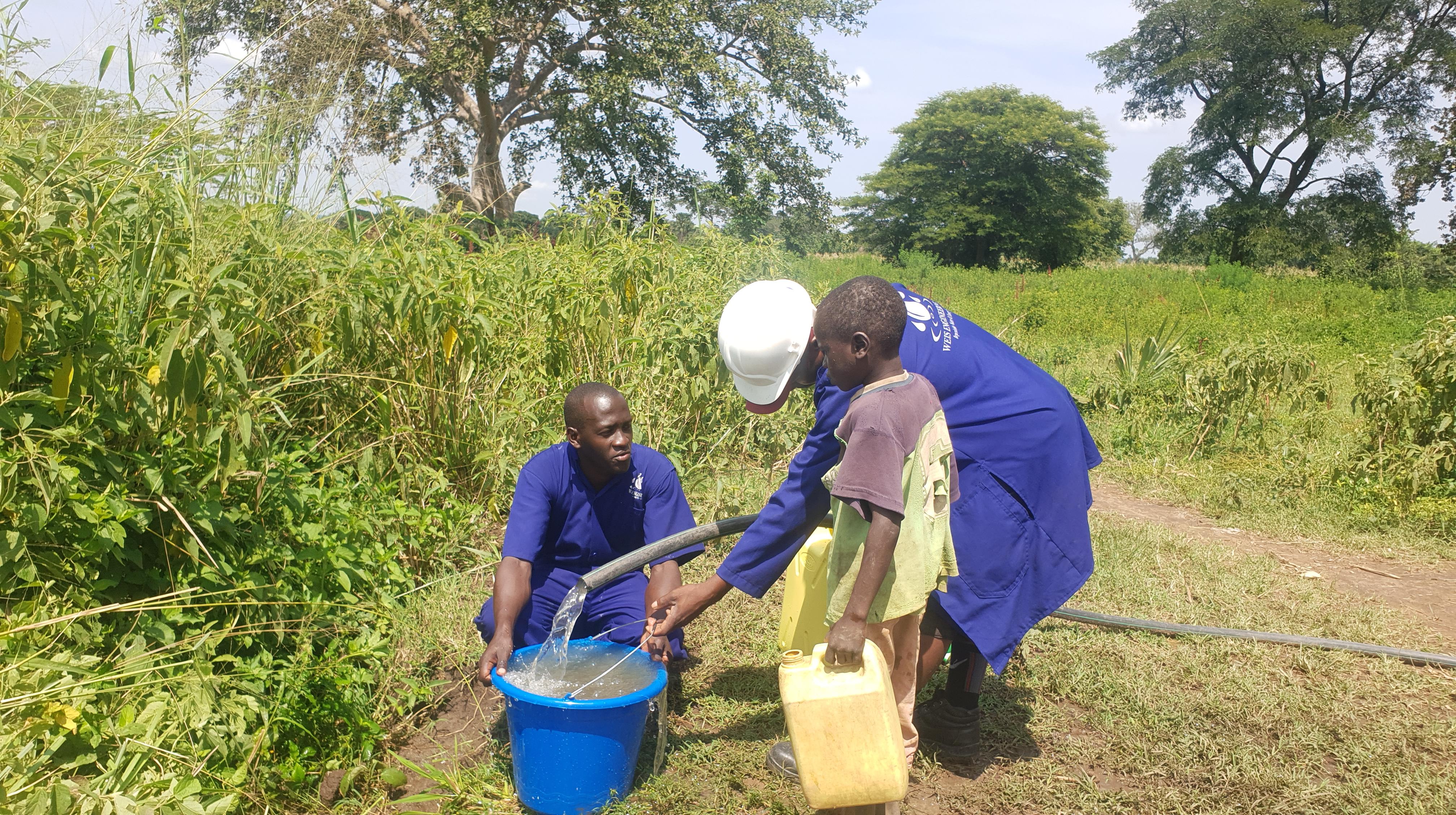


Pump testing in Kassanda district


Pump testing in Mubende district


